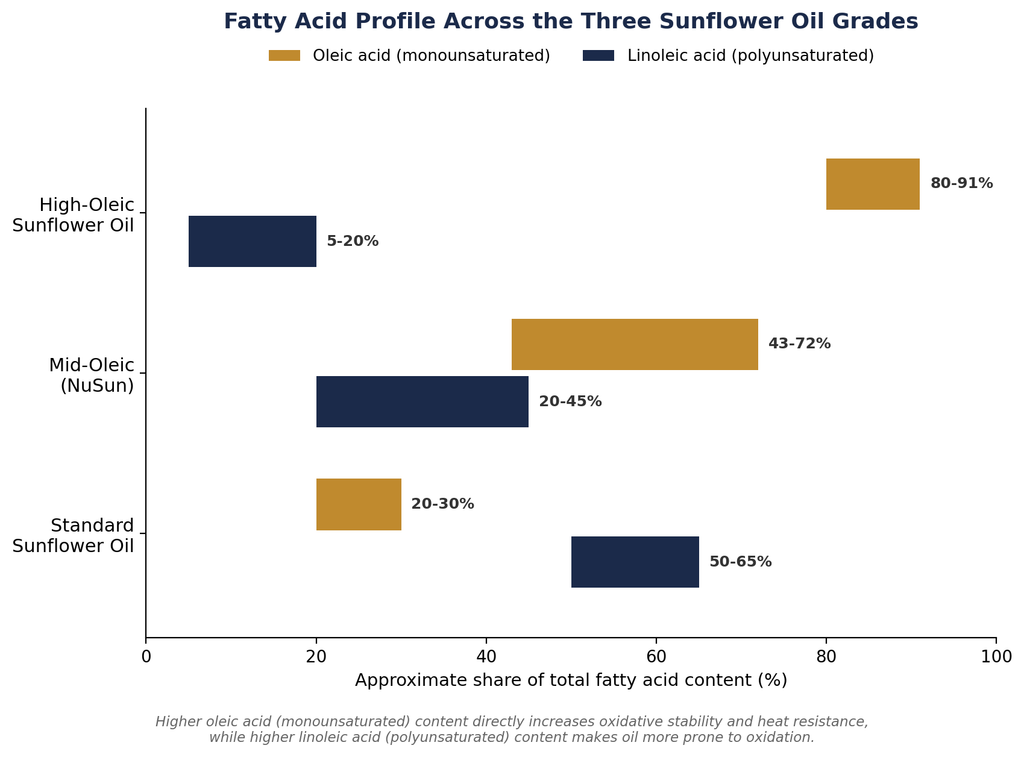
High-oleic sunflower oil is oil pressed from specially bred sunflower seeds engineered to produce a fatty acid profile containing 80% or more oleic acid — a monounsaturated fat — compared to roughly 20-30% oleic acid in standard sunflower oil, which instead consists mostly (50-65%) of linoleic acid, a polyunsaturated fat. This difference in fatty acid composition is the entire basis for high-oleic oil’s key practical advantages: significantly greater oxidative stability, a longer frying life, higher heat resistance, and a longer shelf life, because oleic acid’s molecular structure (fewer carbon-carbon double bonds than linoleic acid) makes it far less prone to breaking down under heat and oxygen exposure. A third, intermediate category — mid-oleic sunflower oil, commonly called NuSun in North America — sits between the two, with roughly 43-72% oleic acid content. This guide explains exactly what distinguishes each grade, why the oleic acid difference matters practically, and what buyers should verify when sourcing high-oleic oil.
The Three Sunflower Oil Grades, by Fatty Acid Profile
High-Oleic vs. Mid-Oleic vs. Standard Sunflower Oil
| Factor | Standard | Mid-Oleic (NuSun) | High-Oleic |
| Oleic acid content | ~20-30% | ~43-72% | ~80-91% |
| Linoleic acid content | ~50-65% | ~20-45% | ~5-20% |
| Oxidative stability | Lowest of the three | Moderate | Highest of the three |
| Typical frying life | Shortest | Moderate | Longest |
| Price positioning | Lowest cost | Mid-range | Premium |
| Common uses | General cooking, baking, retail bottles | Foodservice/commercial kitchens (common in North America) | Industrial frying, packaged snack foods, trans-fat-free food manufacturing |
Figures reflect commonly cited industry ranges; exact oleic acid content varies by seed hybrid, growing conditions, and specific breeding program. Buyers should request a Certificate of Analysis showing the confirmed fatty acid profile for any specific lot.
Why Oleic Acid Content Determines Oil Performance
The practical differences between these three oil grades trace back to a single chemical distinction. Oleic acid is a monounsaturated fatty acid with one carbon-carbon double bond; linoleic acid is a polyunsaturated fatty acid with two. Every additional double bond in a fat molecule creates an additional site vulnerable to oxidation — the chemical reaction responsible for rancidity, off-flavors, and the breakdown of oil under heat. Because high-oleic sunflower oil is dominated by the more stable, single-double-bond oleic acid rather than the more reactive, double-double-bond linoleic acid, it resists oxidative degradation far more effectively during both storage and high-heat cooking. Research comparing high-oleic and standard sunflower hybrids has confirmed this directly: high-oleic varieties can exceed 89% oleic acid content and show measurably lower susceptibility to oxidative degradation than traditional, high-linoleic sunflower oil.
This stability advantage is also why high-oleic oil does not require partial hydrogenation to achieve the shelf life and heat performance historically obtained by hydrogenating less stable oils. Partial hydrogenation was the standard method used to stabilize polyunsaturated oils before its association with trans fats became a major public health and regulatory concern; high-oleic sunflower oil delivers comparable functional stability naturally, through its fatty acid composition alone, making it one of the leading replacements for partially hydrogenated vegetable oils in food manufacturing following trans-fat restrictions in the EU and US.
Where High-Oleic Sunflower Oil Comes From
High-oleic sunflower varieties are the product of conventional plant breeding, not genetic modification. The high-oleic trait originated from a mutant sunflower line first identified and developed through chemical mutagenesis, later mapped to specific locations on the sunflower genome; ongoing plant genetics research continues to identify the specific genes controlling oleic acid expression across different breeding backgrounds. Commercial breeding of high-oleic sunflower hybrids began in earnest in various regions in the 1980s, with production of high-oleic sunflower oil specifically ramping up commercially in the 2000s as hybrid seed became more widely available to growers. Because the trait is bred into the seed itself rather than added during processing, verifying a supplier’s specific hybrid and requesting fatty acid profile testing is the only reliable way to confirm the oleic acid content of a given shipment.
Nutritional Comparison
Both high-oleic and standard sunflower oil are low in saturated fat and free of cholesterol, and both are considered nutritionally reasonable cooking oil choices. The meaningful nutritional distinction is the balance of monounsaturated versus polyunsaturated fat: high-oleic sunflower oil’s dominant monounsaturated fat content is associated with favorable cholesterol profile effects, similar in principle to olive oil, while standard sunflower oil’s higher linoleic acid (an omega-6 polyunsaturated fat) content means moderating overall intake matters more, given that most modern diets already skew heavily toward omega-6 relative to omega-3 fatty acids. Refined sunflower oil, regardless of oleic acid grade, is also a source of vitamin E, typically providing approximately 41-44 mg per 100g in refined form, with less-processed variants sometimes retaining slightly higher levels.
Practical Applications by Grade
Standard sunflower oil
Best suited to general household cooking, baking, and retail bottled oil where cost is a primary consideration and the oil will not be subjected to prolonged or repeated high-heat use.
Mid-oleic (NuSun) sunflower oil
Commonly used in foodservice and commercial kitchens, particularly in North America, where it offers meaningfully better stability than standard oil without the full price premium of high-oleic — a practical middle ground for operations that need better performance than standard oil but don’t require the extended frying life of high-oleic grades.
High-oleic sunflower oil
The preferred choice for industrial and continuous frying operations, packaged snack food manufacturing, and any application where extended shelf life, high-heat stability, and a completely neutral, clean flavor profile are priorities — its mild taste and consistent high-temperature performance make it well suited to baking, sauces, dressings, and large-scale food production alike.
How Buyers Should Verify High-Oleic Claims
Because “high-oleic” is a compositional claim rather than a visually verifiable characteristic, buyers sourcing at wholesale or industrial volume should request a Certificate of Analysis (CoA) confirming the actual fatty acid profile of the specific batch or lot, not just a general product specification sheet. Key parameters to request include:
- Fatty acid profile (via gas chromatography): confirms the actual oleic acid percentage rather than relying on the product name alone
- Free fatty acid (FFA) content and peroxide value: standard quality and freshness indicators applicable across all three oil grades
- Color and mineral oil aromatic/saturated hydrocarbons (MOAH/MOSH): food safety compliance parameters increasingly requested by European buyers specifically
- Country of origin and hybrid/variety information: since oleic acid content can vary by growing region, season, and specific seed genetics even within a nominal “high-oleic” classification
Global Supply Context
Global sunflower oil supply has historically been concentrated in Ukraine and Russia, which together have produced more than 60% of world supply in recent years. The disruption to Ukrainian and Russian sunflower oil exports has led European and international manufacturers to diversify sourcing toward other producing countries, including Argentina, Turkey, and expanded domestic EU production, to maintain supply continuity across all three oleic grades. Buyers should factor this ongoing supply diversification into sourcing strategy, since availability and pricing for high-oleic sunflower oil specifically can be more constrained than standard oil, given that high-oleic hybrid seed is less widely planted globally than conventional sunflower varieties.
Buyer’s Guide: Choosing the Right Sunflower Oil Grade
- Match the grade to your actual heat and shelf-life requirements. Don’t default to high-oleic if your application doesn’t require extended frying life or maximum oxidative stability — mid-oleic or standard oil may deliver adequate performance at a lower cost.
- Request lot-specific fatty acid profile testing for any high-oleic purchase. The oleic acid percentage can vary meaningfully by hybrid, harvest, and growing conditions even within products marketed under the same “high-oleic” label.
- Factor in the price premium against your specific use case. High-oleic oil commands a premium over standard and mid-oleic oil; this premium is easiest to justify in continuous industrial frying or extended-shelf-life packaged food applications where its stability advantage directly reduces waste and reformulation costs.
- Consider high-oleic oil specifically if reformulating away from partially hydrogenated oils. Its natural oxidative stability makes it a leading trans-fat-free replacement option without requiring hydrogenation.
- Diversify sourcing given global supply concentration. Since sunflower oil supply remains concentrated in a small number of producing countries, qualifying more than one origin — particularly for high-oleic grades with more limited planting — helps manage supply continuity risk.
- Clarify grade terminology explicitly in purchase specifications. “High-oleic,” “mid-oleic,” and “NuSun” are not universally standardized terms with identical percentage thresholds across every supplier — specify the exact minimum oleic acid percentage required rather than relying on the category name alone.
Frequently Asked Questions
What percentage of oleic acid makes an oil ‘high-oleic’?
High-oleic sunflower oil is generally defined as containing 80% or more oleic acid, with some specifications and hybrids reaching as high as 89-91%. This compares to roughly 20-30% oleic acid in standard sunflower oil.
Is high-oleic sunflower oil genetically modified?
No. High-oleic sunflower varieties were developed through conventional plant breeding based on a naturally occurring mutant trait, first identified and refined through chemical mutagenesis and subsequent selective breeding, not through genetic engineering.
Why does high-oleic sunflower oil last longer and perform better at high heat?
Oleic acid is a monounsaturated fat with only one carbon-carbon double bond, making it chemically more resistant to oxidation than linoleic acid, a polyunsaturated fat with two double bonds. Since high-oleic sunflower oil contains far more oleic acid and far less linoleic acid than standard sunflower oil, it degrades more slowly under heat and oxygen exposure, extending both frying life and shelf life.
What is mid-oleic or NuSun sunflower oil?
Mid-oleic sunflower oil, commonly marketed as NuSun in North America, is an intermediate grade with roughly 43-72% oleic acid content, offering meaningfully better oxidative stability than standard sunflower oil at a lower cost than true high-oleic grades.
Does high-oleic sunflower oil eliminate the need for trans fats in food manufacturing?
Yes, in many applications. Because high-oleic sunflower oil achieves strong oxidative and heat stability naturally through its fatty acid composition, it does not require partial hydrogenation — the process that creates trans fats — making it a leading replacement for partially hydrogenated oils that have been restricted or banned in the EU and US.
Sources: Tufts University Health & Nutrition Letter; International Sunflower Association (ISA) proceedings on high- and mid-oleic sunflower oil oxidative stability; peer-reviewed QTL mapping research on oleic acid content in sunflower (PMC/NCBI); industry technical guidance on sunflower oil grades and specifications (QP Foods, Nutrada, Wikifarmer). Exact oleic acid percentages vary by hybrid, growing region, and season; buyers should confirm batch-specific figures via Certificate of Analysis.