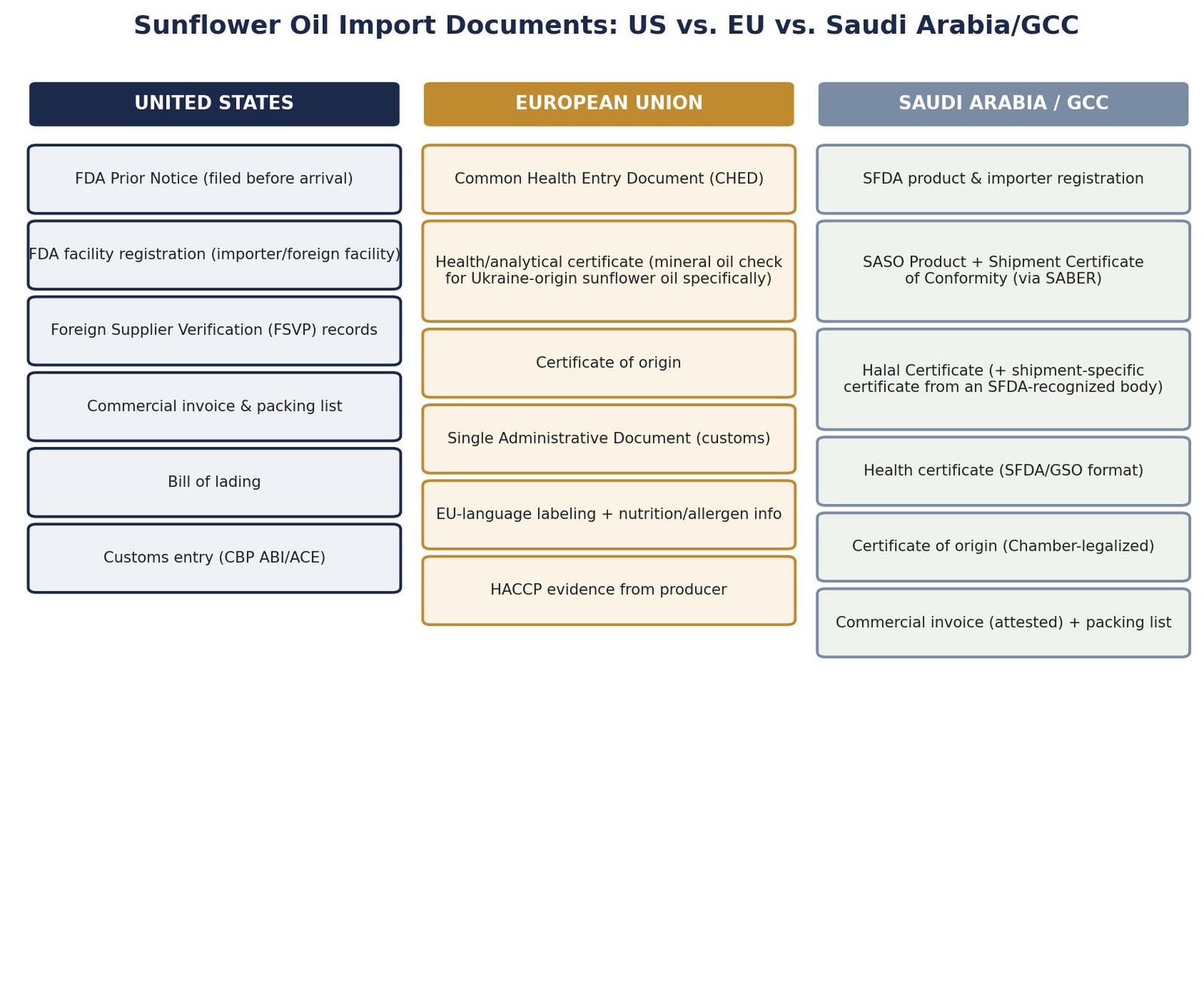
Importing sunflower oil requires a different document set depending on the destination market, though all three major import regions share a common core: a commercial invoice, packing list, bill of lading, certificate of origin, and a health-related certificate confirming food safety compliance. Beyond that shared foundation, the US requires FDA Prior Notice and Foreign Supplier Verification Program (FSVP) documentation; the EU requires a Common Health Entry Document (CHED) filed through the TRACES platform, plus — specifically for Ukraine-origin sunflower oil — an additional certificate confirming mineral oil contamination levels under Commission Regulation (EC) No 1151/2009; and Saudi Arabia/GCC markets require SFDA product registration, SASO Product and Shipment Certificates of Conformity issued through the SABER platform, and a halal certificate paired with a separate shipment-specific halal certificate. This guide breaks down exactly what’s required in each market, including a 2025 Saudi regulatory change that now blocks non-compliant shipments outright rather than allowing them to clear pending documentation.
Document Requirements at a Glance: US vs. EU vs. Saudi Arabia/GCC
Importing Sunflower Oil into the United States
US import documentation for sunflower oil is governed primarily by the FDA rather than by a single unified customs form. Under the Public Health Security and Bioterrorism Preparedness and Response Act of 2002 and the FDA Food Safety Modernization Act (FSMA), the FDA requires a Prior Notice filing before any food shipment, including sunflower oil, arrives at a US port of entry — for shipments arriving by road, this must be submitted no less than two hours before arrival. Separately, the Foreign Supplier Verification Program (FSVP) places responsibility on the US importer of record to verify that the foreign supplier’s food safety practices meet FDA standards, and the producing facility itself must carry current FDA facility registration, renewed every two years.
| Document | Purpose | Issued By / Filed By |
| FDA Prior Notice | Advance notification to FDA before the shipment arrives at a US port of entry, required under the Bioterrorism Act and FSMA | Importer or customs broker, via FDA PNSI or CBP ABI/ACE |
| FDA Facility Registration | Confirms the foreign facility producing, manufacturing, storing, or packing the oil is registered with the FDA | Foreign facility (biennial renewal) |
| Foreign Supplier Verification Program (FSVP) records | Documents that the foreign supplier meets FDA food safety standards equivalent to US requirements | US importer of record |
| Commercial Invoice & Packing List | Transaction value, product description, and exact shipment quantities for customs valuation | Exporter |
| Bill of Lading | Proof of shipment and, for ocean freight, a document of title | Carrier or freight forwarder |
| CBP Customs Entry | Formal entry declaration processed through CBP’s Automated Broker Interface/ACE system | Importer or licensed customs broker |
Importing Sunflower Oil into the European Union
EU import documentation centers on the Common Health Entry Document (CHED) system, a standardized form filed through the European Commission’s TRACES NT platform to notify Border Control Posts of an incoming consignment subject to sanitary or phytosanitary checks. For sunflower oil specifically, buyers should be aware of a targeted EU regulation: Commission Regulation (EC) No 1151/2009 imposes special conditions specifically on sunflower oil originating in or consigned from Ukraine, requiring each consignment to be accompanied by a certificate and analytical report — signed by an authorized representative of Ukraine’s Ministry of Health — confirming mineral oil contamination does not exceed 50 mg/kg, with EU member states additionally authorized to conduct their own random sampling and analysis on arrival. This is a genuine, product-specific regulatory requirement that goes beyond general food import documentation, and it applies regardless of which EU member state is the port of entry.
| Document | Purpose | Issued By / Filed By |
| Common Health Entry Document (CHED) | Standardized EU form notifying Border Control Posts of an incoming consignment subject to sanitary checks, filed via the TRACES NT platform | EU importer, at least prior to arrival |
| Health/Analytical Certificate | Confirms compliance with EU food safety standards; sunflower oil specifically originating in or consigned from Ukraine requires an additional certificate and analytical report confirming mineral oil contamination is below 50 mg/kg, per Commission Regulation (EC) No 1151/2009 | Competent authority in the exporting country (e.g., Ministry of Health for Ukraine-origin oil) |
| Certificate of Origin | Confirms the country of manufacture for tariff and regulatory purposes | Chamber of commerce or trade authority in the exporting country |
| Single Administrative Document (SAD) | The standard EU customs declaration form used for import, export, and transit | Importer or customs broker |
| EU-Compliant Labeling | Ingredient list, nutrition declaration, and allergen information in the destination country’s official language(s), per Regulation (EU) 1169/2011 | Exporter/brand owner, prior to shipment |
| HACCP Documentation | Evidence of a documented food safety management system at the production facility | Exporting facility |
Importing Sunflower Oil into Saudi Arabia and the GCC
Saudi Arabia’s import framework, administered by the Saudi Food and Drug Authority (SFDA), is the most document-intensive of the three markets covered here, and it tightened significantly and recently. Since January 1, 2025, all regulated shipments into Saudi Arabia require both a Product Certificate of Conformity (PCoC), valid for 12 months and covering all shipments of that certified product during the period, and a Shipment Certificate of Conformity (SCoC) issued per individual consignment — both processed through the SASO-administered SABER platform. Critically, Letters of Undertaking that previously allowed shipments to enter pending completed documentation are no longer accepted, and certificates obtained after a shipment’s arrival are now treated as regulatory non-compliance rather than a correctable delay — meaning a shipment missing its SABER certification can face mandatory re-export rather than a hold-and-release outcome.
Halal documentation in Saudi Arabia also involves two distinct certificates, not one: a general Halal Certificate confirming the product and facility meet SFDA.FD/GSO 993 and GSO 2055-1 requirements, and a separate Halal Shipment Certificate, issued under the SFDA Halal Center’s certification scheme specifically for each individual consignment by a certifying body SFDA recognizes. A certifying body accredited elsewhere in the GCC — for example, under the UAE’s MOIAT — does not automatically appear on SFDA’s own recognized list, so buyers should confirm their specific certifier’s Saudi recognition status rather than assuming GCC-wide accreditation transfers automatically between member states.
| Document | Purpose | Issued By / Filed By |
| SFDA Product & Importer Registration | Both the importer and the specific food product must be registered with the Saudi Food and Drug Authority (SFDA) before any shipment can proceed | Importer, via SFDA e-Account; exporter registers as a Foreign Establishment |
| SASO Certificates of Conformity (PCoC + SCoC) | A Product Certificate of Conformity (valid 12 months) plus a Shipment Certificate of Conformity issued per consignment, both processed through the SABER platform — mandatory since January 1, 2025, with no grace period for late documentation | SASO-approved Conformity Assessment Body |
| Halal Certificate + Halal Shipment Certificate | Confirms compliance with SFDA.FD/GSO 993 and GSO 2055-1 halal requirements; the shipment-specific certificate must be issued under the SFDA Halal Center’s scheme by a recognized body, separately from any general product-level halal certificate | SFDA-recognized halal certification body |
| Health Certificate | Follows SFDA-approved or GSO health certificate templates confirming the product’s safety and suitability | Competent authority in the exporting country |
| Certificate of Origin | Must be legalized by the chamber of commerce in the country of origin | Chamber of commerce, exporting country |
| Commercial Invoice & Packing List | The original invoice must be attested by the trade authority in the country of origin | Exporter, with chamber/trade authority attestation |
Common Documentation Pitfalls Across All Three Markets
- Assuming one market’s certification transfers to another. A SASO certificate valid for Saudi Arabia, an FDA-registered facility status, and an EU CHED filing are three entirely separate systems — none substitutes for another, even for the same physical shipment split across markets.
- Treating halal certification as a single document. Saudi Arabia specifically requires both a general Halal Certificate and a separate, shipment-specific Halal Shipment Certificate — a common and costly point of confusion for new exporters.
- Missing the Ukraine-specific EU requirement. Buyers sourcing sunflower oil that originated in or was consigned from Ukraine, even indirectly, need to confirm the mineral oil certificate and analytical report required under EU Regulation 1151/2009 are in place before EU-bound shipment.
- Underestimating Saudi documentation timelines post-2025. With Letters of Undertaking no longer accepted, there is no longer a documentation grace period at the Saudi border — PCoC and SCoC certification must be complete before the shipment departs, not arranged while it’s in transit.
- Filing FDA Prior Notice too close to arrival. The minimum notice windows (as little as two hours for road shipments) are legal minimums, not recommended practice — building in buffer time avoids shipment holds caused by an unconfirmed Prior Notice submission.
Buyer’s Guide: Preparing Your Documentation by Market
- Identify your destination market’s specific regulatory body before sourcing. FDA (US), the European Commission via TRACES (EU), and SFDA/SASO (Saudi Arabia) each operate independent systems with no cross-recognition between them.
- Confirm your supplier’s origin-specific requirements. If sourcing sunflower oil of Ukrainian origin for EU import, confirm the mineral oil certificate and analytical report are available before shipment, not after arrival.
- For Saudi-bound shipments, complete SABER certification before departure, not during transit. Since January 2025, incomplete documentation on arrival risks mandatory re-export rather than a correctable hold.
- Verify your halal certifier’s specific recognition in your destination country. GCC-wide accreditation does not guarantee recognition by SFDA specifically — check the current recognized list rather than assuming regional accreditation transfers.
- Build realistic documentation lead time into your shipping schedule. Between FDA Prior Notice, EU CHED filing, and Saudi PCoC/SCoC issuance, expect meaningful advance preparation time in every market — none of these are same-day processes for a first shipment.
- Request your supplier’s current registration status directly. For all three markets, ask for proof of current FDA facility registration, EU-recognized producer status, or SFDA foreign establishment registration, rather than assuming a supplier’s export history guarantees current compliance.
Related Reading from This Series
- What Certifications Should Sunflower Oil Exporters Have? — the full certification landscape (HACCP, FSSC 22000, BRCGS, Halal, ISCC) referenced throughout this article
- Turkish Sunflower Oil vs. Ukrainian Sunflower Oil — relevant background on why EU import rules specifically target Ukraine-origin sunflower oil for additional certification
- How Do Sunflower Oil Prices Vary by Origin? — how documentation and market access requirements factor into landed cost across origins
Need Help Navigating Import Documentation? Talk to Safya
Safya exports HACCP-certified refined and high-oleic sunflower oil from Mersin, Türkiye, to more than 70 countries, with export documentation already structured for EU, US, and GCC market requirements. Our export team can provide current Certificates of Analysis, halal and shipment certification, and the supporting documentation your specific destination market requires. Visit www.safyaoils.com to request a quote or speak directly with our export compliance team.
Frequently Asked Questions
What is FDA Prior Notice and is it required for sunflower oil imports?
Yes. FDA Prior Notice is an advance notification required for virtually all food shipments, including sunflower oil, entering the United States, submitted through the FDA Prior Notice System Interface or via CBP’s ABI/ACE system. It must be confirmed by FDA before the shipment arrives, with minimum notice windows as short as two hours for shipments arriving by road.
Why does the EU require special certification for Ukraine-origin sunflower oil specifically?
Commission Regulation (EC) No 1151/2009 requires sunflower oil originating in or consigned from Ukraine to be accompanied by a certificate and analytical report confirming mineral oil contamination does not exceed 50 mg/kg, addressing a specific historical contamination risk identified in that supply chain. This requirement is specific to Ukraine-origin oil and does not apply uniformly to sunflower oil from other origins.
What changed with Saudi Arabia’s import certification requirements in 2025?
Effective January 1, 2025, Saudi Arabia stopped accepting Letters of Undertaking that previously allowed shipments to clear customs pending completed documentation. All regulated shipments now require both a Product Certificate of Conformity and a Shipment Certificate of Conformity, issued through the SABER platform, completed before arrival — certificates obtained after the shipment arrives are treated as non-compliance rather than a correctable delay.
Is one halal certificate enough to import sunflower oil into Saudi Arabia?
Not necessarily. Saudi Arabia’s SFDA typically requires both a general Halal Certificate confirming the product and facility meet halal requirements, and a separate Halal Shipment Certificate issued specifically for each consignment under the SFDA Halal Center’s certification scheme by a recognized certifying body.
Do EU, US, and Saudi Arabian import certifications transfer between markets?
No. Each market operates an independent regulatory and certification system — FDA registration and Prior Notice in the US, CHED filings through TRACES in the EU, and SFDA/SASO certification in Saudi Arabia — with no automatic recognition of another market’s certificates or registrations.
Sources: U.S. FDA, Prior Notice of Imported Food regulations (21 CFR Part 1, Subpart I) and FSVP guidance; USA Customs Clearance, Importing Sunflower Oil guide; European Commission, Commission Regulation (EC) No 1151/2009 (EUR-Lex); Food Safety Authority of Ireland, Food Imports and CHED guidance; QIMA, SASO Certificate & SABER Platform guidance (2025 update); Saudi Food and Drug Authority (SFDA), Food Consignment Certification Programme Exporter and Importer Guidelines; ChemLinked, Saudi Arabia Food Regulation; USDA Foreign Agricultural Service, Food and Agricultural Import Regulations and Standards, Saudi Arabia. Import documentation requirements change periodically; buyers and exporters should confirm current requirements directly with the relevant regulatory authority before shipment.