Sunflower oil and corn oil are close functional equivalents in the kitchen: both are refined, neutral-flavored seed oils with high smoke points (sunflower oil at approximately 440-450°F/227-232°C, corn oil at approximately 400-450°F/204-232°C), and both perform similarly for deep frying, stir-frying, roasting, and baking. The meaningful differences lie in their fatty acid balance and micronutrient content — standard sunflower oil carries noticeably more monounsaturated fat and roughly three times more vitamin E than corn oil, while corn oil carries more polyunsaturated fat and a unique profile of plant sterols not found in the same concentration in sunflower oil. For most everyday cooking and frying applications, the two oils are close to interchangeable; the differences that matter most emerge specifically around oxidative stability during repeated high-heat use and the broader dietary omega-6 balance question. This guide breaks down the verified data buyers and cooks need to choose between them.
Fatty Acid Composition Compared
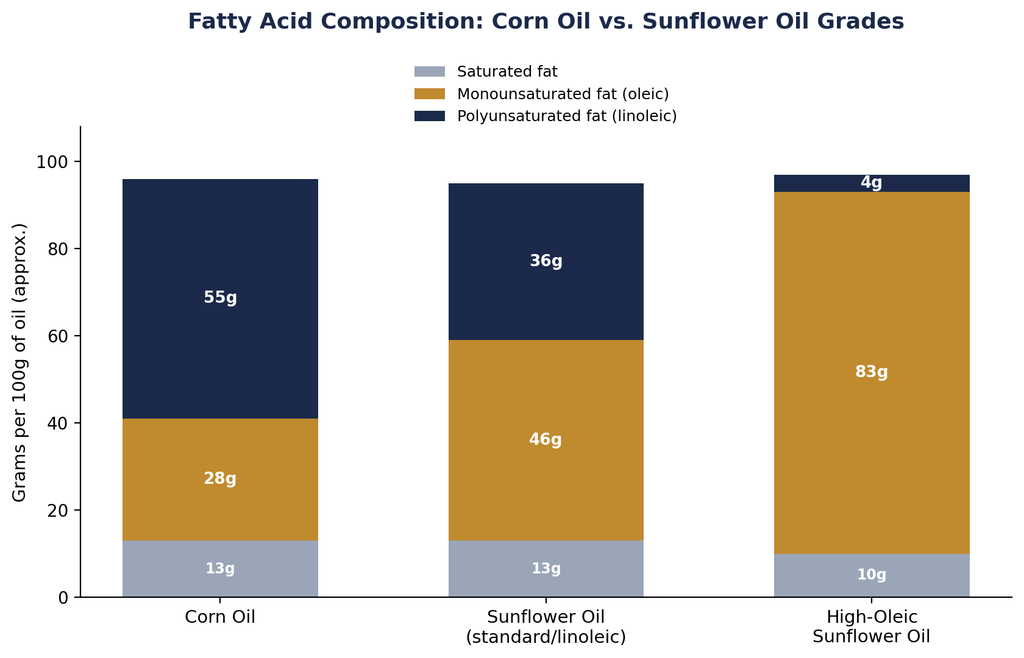
Standard sunflower oil and corn oil are both dominated by polyunsaturated linoleic acid, but in different proportions: corn oil runs approximately 55g of polyunsaturated fat per 100g against roughly 28g of monounsaturated fat, while standard sunflower oil runs closer to 36g polyunsaturated against 46g monounsaturated. This means, gram for gram, standard sunflower oil already leans more toward the more oxidation-resistant monounsaturated fat family than corn oil does — a real, measurable compositional difference, even before factoring in high-oleic sunflower oil varieties, which push monounsaturated content as high as 80% or more of total fat and represent the most heat-stable option across both oil categories entirely.
Sunflower Oil vs. Corn Oil: Full Comparison
| Factor | Corn Oil | Sunflower Oil (Standard/Refined) |
| Smoke point (refined) | 400-450°F (204-232°C) | 440-450°F (227-232°C) |
| Saturated fat (per 100g) | ~13g | ~13g |
| Monounsaturated fat (per 100g) | ~28g | ~46g (standard); varies by variety |
| Polyunsaturated fat (per 100g) | ~55g | ~36g (standard) |
| Vitamin E content | ~14mg per 100g | ~41mg per 100g — roughly 3x more than corn oil |
| Flavor | Neutral, very mild corn taste | Neutral, essentially flavorless |
| Behavior under high heat | Prone to aldehyde formation like other high-PUFA oils | Prone to aldehyde formation like other high-PUFA oils |
| Best suited for | Deep frying, baking, general high-heat cooking | Deep frying, roasting, baking, general high-heat cooking |
| Unique compositional note | Rich in plant sterols (ferulic acid esters), a minor component largely unique to corn oil among common vegetable oils | High vitamin E (tocopherol) content relative to most seed oils |
Figures reflect standard nutrition database reference values and commonly cited industry smoke point ranges; exact composition varies by seed variety, growing region, and specific refining process. Note that some North American sunflower oil supply now derives from mid-oleic (NuSun) hybrids, which shifts the monounsaturated/polyunsaturated balance somewhat higher in oleic acid than traditional linoleic-type sunflower oil more commonly used across Europe and Turkey.
Smoke Point: Which Oil Handles Higher Heat?
Both oils sit firmly in the high-heat category suitable for deep frying, but refined sunflower oil’s smoke point (440-450°F/227-232°C) runs slightly higher than corn oil’s typical range (400-450°F/204-232°C), according to USDA Food Safety and Inspection Service reference data. In practice, this difference rarely matters for typical home or commercial frying temperatures, which usually run between 350-375°F (177-190°C) — both oils comfortably exceed the temperatures most frying actually requires. The gap becomes more relevant only in continuous, high-volume industrial frying operations running consistently closer to each oil’s upper thermal limit.
Nutrition: Where the Two Oils Genuinely Differ
The most consistent, well-documented nutritional difference between the two is vitamin E content: sunflower oil provides approximately 41mg of vitamin E per 100g, compared to approximately 14mg per 100g in corn oil — roughly three times more. Vitamin E functions as a natural antioxidant, which also modestly supports sunflower oil’s own oxidative stability during storage and cooking, independent of its fatty acid profile. Corn oil, in turn, is distinguished by a comparatively high concentration of plant sterols, in both free and ferulic-acid-esterified forms — a minor but distinctive compositional feature not shared to the same degree by most other common vegetable oils, including sunflower oil.
Both oils are similar in calorie content (approximately 884-900 kcal per 100g, or about 120 calories per tablespoon, consistent with all pure vegetable oils) and are both relatively low in the omega-3 fatty acid ALA, meaning both contribute to the same broader dietary omega-6-to-omega-3 imbalance that nutrition researchers flag as a general concern with heavy reliance on either oil as a primary fat source.
How Each Oil Behaves Under Repeated High-Heat Frying
This is the area where the two oils are most alike — and where that similarity is itself the important finding. A 2018 study published in Acta Scientific Nutritional Health found that oils high in polyunsaturated fats, specifically naming both sunflower oil and corn oil together, produced two to three times more aldehydes (a marker of oxidative breakdown linked to off-flavors and potential health concerns) than oils dominated by monounsaturated fat, such as olive or avocado oil, when heated beyond their smoke point. Separately, food science research on frying oil degradation confirms that oils rich in monounsaturated oleic acid resist thermal degradation more effectively than oils rich in linoleic acid — the dominant fatty acid in both standard corn oil and standard sunflower oil. In practical terms: neither corn oil nor standard sunflower oil holds a meaningful advantage over the other for repeated, extended frying use, since both share the same underlying vulnerability tied to their shared reliance on linoleic acid.
This is also precisely why high-oleic sunflower oil occupies a different category from both standard sunflower oil and corn oil for heavy-duty or continuous frying applications — its dominant oleic acid content gives it meaningfully better resistance to the same oxidative breakdown process, a genuine compositional advantage rather than a marketing distinction.
Practical Guidance by Use Case
For everyday home cooking and occasional frying
Either oil performs well. The practical differences (smoke point, minor nutrient variation) are unlikely to be noticeable in typical use, and the choice can reasonably come down to price, availability, or personal flavor preference.
For commercial or continuous frying operations
Consider high-oleic sunflower oil specifically over either standard sunflower oil or corn oil, given its documented superior resistance to oxidative breakdown under repeated heat exposure — a meaningful factor when oil is reused across many frying cycles, since it directly affects both food quality consistency and how frequently the frying oil needs to be changed.
For baking and general food manufacturing
Both oils’ neutral flavor profiles make them broadly interchangeable in recipe formulation; corn oil’s distinct minor sterol content is occasionally specifically requested in formulations targeting a plant-sterol nutritional claim, since sunflower oil does not carry sterols in comparable concentration.
If minimizing omega-6 intake is a specific dietary priority
Neither standard corn oil nor standard sunflower oil is well suited to this goal, since both are dominated by omega-6 linoleic acid; high-oleic sunflower oil offers a meaningfully lower omega-6 content and is the more suitable choice within this comparison specifically for that dietary consideration.
Buyer’s Guide: Choosing Between Sunflower Oil and Corn Oil
- For most food manufacturing and foodservice applications, treat the two as functionally interchangeable and choose based on cost, supply reliability, and regional availability rather than assuming one has a decisive performance edge.
- For continuous or high-volume frying operations, prioritize high-oleic sunflower oil over either standard sunflower oil or corn oil, given its documented oxidative stability advantage — the cost premium is often justified by extended usable frying life and more consistent finished-product quality.
- Confirm which sunflower oil variety you’re actually being quoted. Standard (linoleic) and high-oleic sunflower oil have meaningfully different fatty acid profiles and performance characteristics — don’t assume a generic “sunflower oil” quote reflects the same product across different suppliers.
- If your product formulation or marketing specifically references a fatty acid or micronutrient claim (such as vitamin E content or a specific omega-6 level), request a Certificate of Analysis confirming the exact composition for your batch, since natural variation exists even within the same nominal oil type.
- For products marketed on a plant sterol or specific minor-component claim, corn oil’s distinct sterol profile may be the more relevant choice — verify this with your ingredient formulation team rather than defaulting to sunflower oil on general nutrition assumptions.
- Don’t rely on smoke point alone to choose between the two for frying applications. Since most real-world frying occurs well below either oil’s smoke point, oxidative stability under repeated heat exposure — not the smoke point number — is the more relevant practical performance factor for continuous-use applications.
Frequently Asked Questions
Which has a higher smoke point, sunflower oil or corn oil?
Refined sunflower oil has a slightly higher typical smoke point (440-450°F/227-232°C) than corn oil (400-450°F/204-232°C), according to USDA Food Safety and Inspection Service reference data, though both are well within the range needed for standard deep frying and high-heat cooking.
Is sunflower oil healthier than corn oil?
Standard sunflower oil contains more monounsaturated fat and roughly three times more vitamin E than corn oil, which are modest nutritional advantages. However, both oils are similarly high in omega-6 linoleic acid and behave similarly under high-heat frying, so neither represents a dramatically healthier choice than the other in typical use — the more meaningful health-related distinction is between standard sunflower oil and high-oleic sunflower oil specifically.
Do sunflower oil and corn oil taste different?
Both are considered neutral-tasting oils suitable for a wide range of dishes without altering flavor significantly. Corn oil carries a very mild, slightly perceptible corn note in some assessments, while refined sunflower oil is generally considered essentially flavorless.
Can I substitute corn oil for sunflower oil in a recipe?
Yes, in nearly all cooking and frying applications, the two can be substituted for each other directly, given their similar smoke points and neutral flavor profiles. The substitution is less appropriate only in formulations specifically relying on corn oil’s distinct plant sterol content or on sunflower oil’s higher vitamin E level for a specific nutritional claim.
Which oil is better for deep frying multiple times?
High-oleic sunflower oil outperforms both standard sunflower oil and corn oil for repeated or continuous frying, since its high monounsaturated fat content resists the oxidative breakdown that generates aldehydes and off-flavors under heat more effectively than the linoleic-acid-dominant profile shared by standard sunflower oil and corn oil alike.
Sources: USDA Food Safety and Inspection Service, oil smoke point reference data; FoodStruct, Corn Oil vs. Sunflower Oil Nutrition Comparison (USDA FoodData Central); Acta Scientific Nutritional Health (2018), aldehyde formation in polyunsaturated vs. monounsaturated frying oils; “Vegetable Oils and Their Use for Frying: A Review of Their Compositional Similarities and Differences,” PMC/NCBI; Global Resources Direct, Corn Oil: Pros, Cons, and Everything to Know. Fatty acid and micronutrient values vary by seed variety, region, and refining process; buyers should confirm batch-specific figures via Certificate of Analysis.