Refined sunflower oil is extracted and then chemically processed — degummed, neutralized, bleached, winterized, and deodorized — to produce a neutral-tasting, clear oil with a high smoke point of approximately 227°C (440°F) and a free fatty acid (FFA) content below 0.1%. Unrefined (cold-pressed) sunflower oil is made using mechanical pressing alone, at temperatures below 49°C (120°F), with no chemical treatment, retaining more of its natural color, nutty flavor, and vitamin E content, but with a lower smoke point of around 160°C (320°F) and a shorter shelf life. The right choice depends entirely on intended use: refined oil suits high-heat cooking, frying, and food manufacturing, while unrefined oil suits dressings, finishing, and low-heat applications where flavor and nutrient retention matter more than heat tolerance. This guide breaks down the verified technical differences buyers and cooks should understand.
How Each Oil Is Made
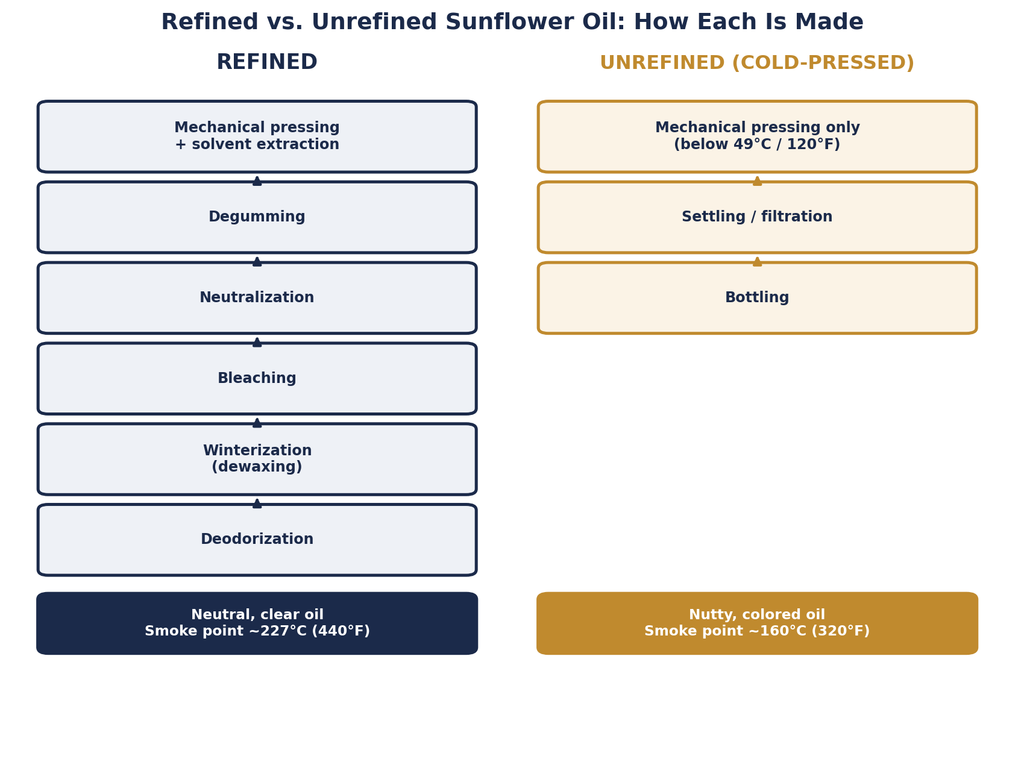
Refined sunflower oil begins with mechanical pressing and, in many industrial processes, solvent extraction to maximize yield from the seed. The resulting crude oil then goes through five main refining stages: degumming (removing phospholipids), neutralization (removing free fatty acids), bleaching (removing pigments), winterization or dewaxing (removing waxes that would otherwise cloud the oil at low temperatures), and deodorization (removing volatile compounds that cause flavor and odor under high heat). A peer-reviewed study on sunflower oil refining documented the measurable effect of this process: phosphorus content dropped from 6.15 ppm to effectively zero, FFA content fell from 1.1% to 0.24%, peroxide value dropped from 22.5 to 7.9 meq/kg, and wax content fell from 1,420 ppm to 200 ppm between crude and refined oil.
Unrefined (cold-pressed) sunflower oil skips this chemical processing entirely. Seeds are mechanically pressed at low temperature, and the resulting oil is only settled and/or filtered before bottling — no degumming, neutralization, bleaching, or deodorization occurs. This preserves more of the oil’s natural compounds but also means more of the seed’s natural impurities, color, and flavor compounds remain in the final product.
Refined vs. Unrefined: Full Technical Comparison
| Factor | Refined Sunflower Oil | Unrefined (Cold-Pressed) Sunflower Oil |
| Extraction method | Mechanical pressing and/or solvent extraction, followed by chemical refining | Mechanical pressing only, at temperatures below 49°C (120°F); no chemicals or heat-based extraction |
| Processing steps | Degumming, neutralization, bleaching, winterization (dewaxing), and deodorization | Settling and/or filtration only |
| Smoke point | Approximately 227°C (440°F), some sources report up to 232°C (450°F) | Approximately 160°C (320°F) |
| Free fatty acid (FFA) content | Below 0.1% | Typically below 2% for food-grade cold-pressed oil |
| Peroxide value | Under 1-10 meq O₂/kg depending on buyer specification, reflecting effective deodorization | Generally higher than refined oil, reflecting minimal processing |
| Color | Under 1.5 Lovibond red units — pale yellow, clear | Deeper golden-yellow to amber; visibly cloudier |
| Flavor and aroma | Neutral, virtually odorless | Nutty, seed-forward flavor and aroma |
| Vitamin E (tocopherol) content | Reduced during refining, though some remains | Higher; unrefined oil can retain roughly 700-900 mg/kg of tocopherols |
| Typical shelf life | 12-24 months, stored cool and dark | 6-12 months, stored cool and dark |
| Best culinary use | High-heat frying, baking, professional kitchens, packaged food manufacturing | Salad dressings, low-heat sautéing, finishing oil |
Figures reflect commonly cited industry and food-science reference ranges; exact values vary by seed variety, harvest conditions, and specific processing parameters. Buyers should request a Certificate of Analysis (CoA) for lot-specific figures rather than relying on general reference ranges alone.
Nutritional Differences
Both refined and unrefined sunflower oil are predominantly composed of unsaturated fats, chiefly linoleic acid (an omega-6 polyunsaturated fat) in standard sunflower oil varieties, or oleic acid in high-oleic varieties. The meaningful nutritional difference lies in micronutrient retention: unrefined oil retains substantially more vitamin E (tocopherols), natural antioxidants, and phytosterols, since these heat- and chemical-sensitive compounds are reduced during the bleaching and deodorization stages of refining. Refined oil still contains beneficial unsaturated fats but in a form stripped of many of the accompanying micronutrients present in the original seed. Because both oil types are relatively high in omega-6 fatty acids, nutrition guidance generally recommends moderating overall intake and balancing it with omega-3 sources (such as fatty fish, flaxseed, or walnuts), regardless of whether the sunflower oil used is refined or unrefined.
Smoke Point and Cooking Applications
The smoke point — the temperature at which an oil begins to visibly smoke and break down — is the most practically important difference for cooks and foodservice buyers. Refined sunflower oil’s smoke point of approximately 227°C (440°F) makes it well suited to deep frying, high-heat sautéing, and baking, and is a major reason it is favored in professional kitchens and industrial food manufacturing. Unrefined sunflower oil’s lower smoke point of approximately 160°C (320°F) means it degrades and produces harmful compounds more readily under high heat, so it is better reserved for salad dressings, low-heat sautéing, or as a finishing oil drizzled over a dish after cooking, where its flavor and nutrient content can be appreciated without being destroyed by heat.
Shelf Life and Storage
Refined sunflower oil typically holds for 12-24 months when stored in a cool, dark place away from heat and light, since the refining process removes many of the compounds that would otherwise accelerate oxidation and rancidity. Unrefined, cold-pressed sunflower oil typically holds for only 6-12 months under the same storage conditions, reflecting its higher natural impurity content and lack of chemical stabilization. Nitrogen-flushed packaging can extend the practical shelf life of either type by limiting oxygen exposure. Buyers and consumers should store both types away from direct sunlight and heat sources, since light and warmth accelerate oxidative rancidity regardless of oil type.
Quality Standards and Specifications Buyers Should Check
For wholesale, import, and food-manufacturing buyers, several standardized quality parameters — beyond smoke point and FFA — are used to verify sunflower oil quality and authenticity:
- Iodine value: typically 118-141 g I₂/100g for standard linoleic sunflower oil, used to characterize the degree of unsaturation and help verify oil type/origin
- Saponification value: typically 188-194 mg KOH/g, another chemical marker used to verify oil authenticity
- Peroxide value: measures oxidation/rancidity level; buyers should request current batch figures rather than relying on general category averages, since this value changes with storage time and conditions
- Fatty acid profile (GC/MS testing): used to confirm the oil matches its declared type and to detect adulteration with cheaper oils such as soybean or palm olein
- Heavy metal and pesticide residue testing: commonly specified limits include lead below 0.1 ppm; buyers sourcing internationally should request third-party lab certificates rather than relying on supplier assurance alone
Regulatory requirements also vary by destination market: EU-bound shipments must meet hygiene standards under Regulation (EC) No 852/2004, while US-bound shipments require compliance with FDA 21 CFR Part 110 food manufacturing regulations. Refined sunflower oil is broadly recognized as GRAS (Generally Recognized As Safe) by the FDA; unrefined grades intended for food use must still meet the same fundamental FFA, peroxide, and contaminant thresholds documented on a Certificate of Analysis, even without undergoing chemical refining.
Which One Should You Choose?
Choose refined sunflower oil if:
- You need a high smoke point for frying, deep-frying, or high-heat baking
- You want a neutral flavor that won’t affect the taste of the final dish
- You’re sourcing for professional foodservice or industrial food manufacturing, where consistency and shelf stability matter
- You need a longer shelf life for inventory or distribution purposes
Choose unrefined (cold-pressed) sunflower oil if:
- You’re using it for salad dressings, dips, or as a finishing oil rather than for cooking
- You want to retain more of the oil’s natural vitamin E and antioxidant content
- You’re marketing to health-conscious or “clean label” consumers who prioritize minimal processing
- You can manage a shorter shelf life and slightly higher price point
Buyer’s Guide: Sourcing Refined or Unrefined Sunflower Oil
- Match the product type to its end use before requesting quotes. A foodservice or industrial buyer needing a high smoke point should specify refined oil explicitly; a specialty or clean-label brand should specify cold-pressed/unrefined and confirm the exact extraction temperature used.
- Always request a Certificate of Analysis (CoA) for the specific batch or lot, not a general product spec sheet. FFA, peroxide value, and color can vary between production runs even within the same product category.
- Verify regulatory compliance for your destination market specifically. Confirm EU hygiene regulation compliance, FDA 21 CFR Part 110 compliance, or the equivalent standard for your import market, rather than assuming a general “food grade” claim covers your specific requirements.
- Ask about adulteration testing for unrefined/cold-pressed oil specifically. Because unrefined oil commands a price premium, it is more prone to fraudulent blending with cheaper refined oils — request GC/MS fatty acid profile testing to confirm authenticity.
- Plan inventory turnover around the shorter shelf life of unrefined oil. A 6-12 month shelf life window requires tighter inventory management than refined oil’s 12-24 month window, particularly for import volumes with longer transit times.
- For halal, kosher, or organic-positioned product, confirm certification separately from the refined/unrefined distinction. Neither refining status nor cold-pressing automatically implies any of these certifications — each must be independently verified with the specific certifying body.
Frequently Asked Questions
Is unrefined sunflower oil healthier than refined sunflower oil?
Unrefined sunflower oil retains more vitamin E, antioxidants, and phytosterols than refined oil, since these compounds are reduced during the bleaching and deodorization stages of refining. However, both types provide similar core fatty acid content, and refined oil remains a safe, widely used cooking oil — the nutritional advantage of unrefined oil is meaningful but should be weighed against its lower smoke point and shorter shelf life.
Can you fry with unrefined sunflower oil?
It is not recommended for high-heat frying. Unrefined sunflower oil has a smoke point of approximately 160°C (320°F), well below the temperatures typically used for deep frying, and will break down and produce off-flavors and potentially harmful compounds if overheated. Refined sunflower oil, with a smoke point of approximately 227°C (440°F), is the appropriate choice for frying.
Why does refined sunflower oil last longer than unrefined?
Refined sunflower oil typically holds for 12-24 months, compared to 6-12 months for unrefined oil, because the refining process removes phospholipids, waxes, and other natural compounds that would otherwise accelerate oxidation and rancidity during storage.
What does FFA (free fatty acid) content tell you about sunflower oil quality?
FFA content indicates how much the oil’s triglycerides have broken down, which affects both quality and shelf stability. Refined sunflower oil typically shows FFA below 0.1%, while unrefined, minimally processed oil is typically under 2% for food-grade product — a higher FFA than either of these ranges can indicate poor-quality or degraded oil.
How can buyers verify that cold-pressed sunflower oil is genuine and not blended with refined oil?
Buyers should request GC/MS (gas chromatography-mass spectrometry) fatty acid profile testing on the specific batch, along with a full Certificate of Analysis showing FFA, peroxide value, and tocopherol content, since these markers can reveal blending with cheaper refined oils that wouldn’t be apparent from color or flavor alone.
Sources: peer-reviewed study on sunflower oil refining, PMC/NCBI (“Effect of refining on quality and composition of sunflower oil”); industry technical guidance on sunflower oil processing, quality parameters, and wholesale sourcing (QP Foods, HBNO Bulk); FDA 21 CFR Part 110; EU Regulation (EC) No 852/2004. Exact technical values vary by seed variety, harvest, and processing conditions; buyers should confirm batch-specific figures via Certificate of Analysis.



One Response